

Vector Databases and Voice Embeddings: The Memory Layer of Modern AI
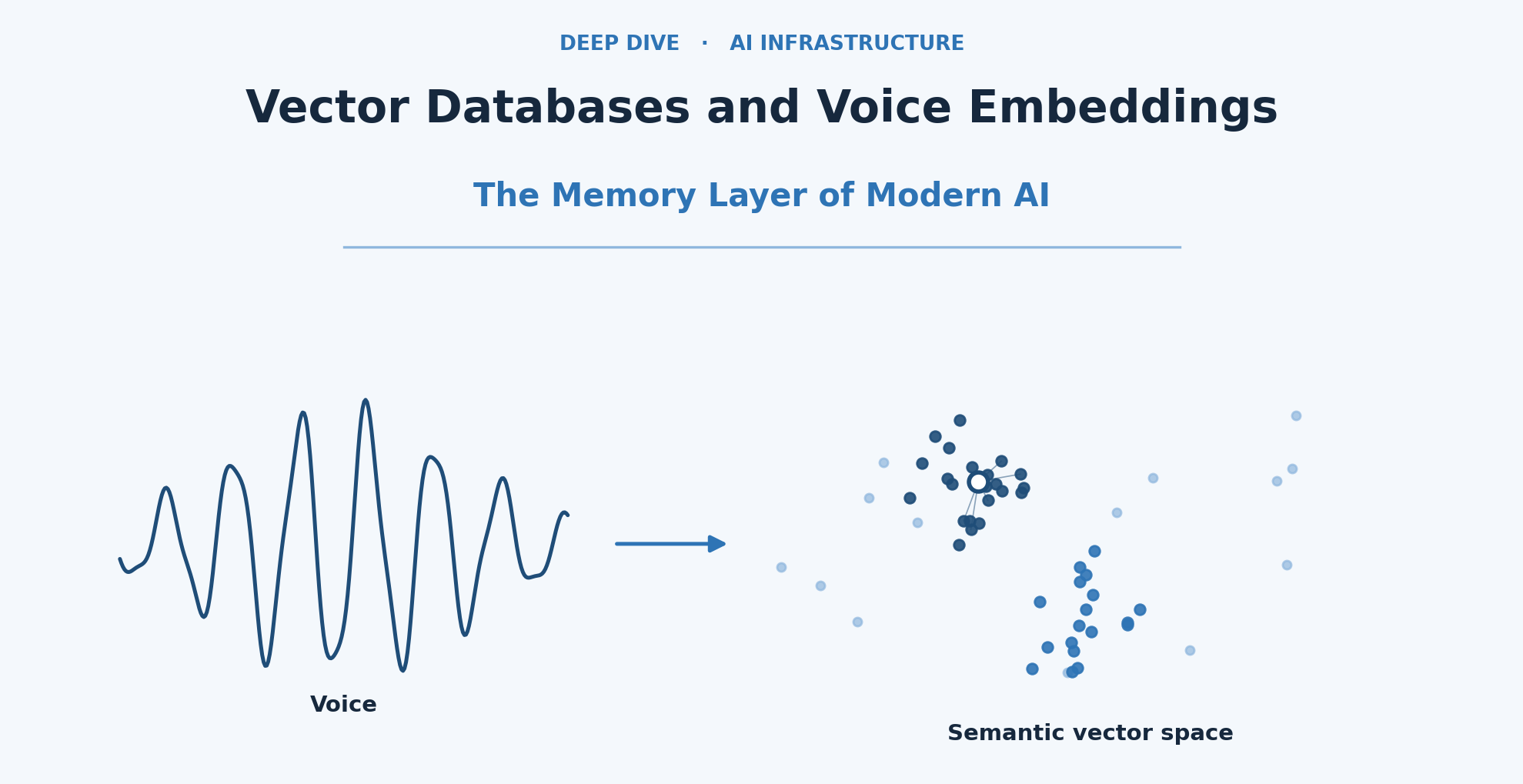 Language models can reason brilliantly but they forget everything between sessions. Vector databases solve that. And when combined with voice, they unlock something remarkable: machines that can find meaning in sound.
Ask a language model about your company’s internal documents or a customer call from last month, and it will confabulate or admit ignorance. The model is smart but it just has no memory. Vector databases are the solution, and they work in a fundamentally different way than anything most engineers have used before.
What is an embedding?
An embedding converts any piece of information, a sentence, an image, a sound clip into a list of numbers called a vector. That vector encodes meaning, not just surface form. Two sentences that mean the same thing produce vectors that are numerically close together, even if they share no words. This turns qualitative similarity into measurable distance, and measuring distance between millions of vectors at speed is exactly what a vector database does.
Traditional databases retrieve by exact match: find the row where user_id = 4821. A vector database retrieves by proximity: find the 10 vectors nearest to this query. Using Approximate Nearest Neighbor (ANN) algorithms FAISS, HNSW, IVF systems can search hundreds of millions of vectors in under 10 milliseconds. The result is semantic search: find documents by meaning, not keywords.
This is the foundation of Retrieval Augmented Generation (RAG) giving AI models access to private, current knowledge at query time, without retraining.
Voice embeddings: where it gets interesting
Voice carries two completely different types of information simultaneously: what is being said (the words), and how it is being said (the speaker’s identity, emotional tone, accent, pace). Voice embeddings encode both, and they can be stored and searched independently.
Models like OpenAI’s Whisper handle transcription, converting speech to text for conventional semantic embedding. Speaker embedding models built on x-vector or d-vector architectures go further, encoding the acoustic fingerprint of a voice into a compact vector entirely independent of the words spoken. Two recordings of the same person saying completely different things will produce very similar speaker vectors.
 The pipeline
- Audio ingestion Raw audio is preprocessed into mel spectrograms
- Transcription Whisper converts speech to timestamped text with speaker diarization
- Dual embedding Semantic embedding of transcript content + speaker embedding of acoustic characteristics, generated in parallel
- Indexing Both vectors stored in Pinecone, Weaviate, Qdrant, or pgvector with metadata
- Retrieval Text or voice query is embedded; ANN search returns ranked results in milliseconds
The power comes from searching both embeddings together. You can now ask: “find every call where this specific customer expressed frustration about billing” regardless of the exact words used, across thousands of hours of audio, in under a second.
Applications across sectors
- Customer intelligence: Semantic retrieval across call centre recordings without keyword matching
- Security: Voice biometric authentication by comparing speaker embeddings against enrolled vectors
- Healthcare: Semantic search across clinical consultation recordings
- Compliance: Scanning recorded calls for policy violations using similarity search
What engineers need to know
Three challenges matter most at scale. First, embedding drift: when model updates shift the vector space, older embeddings become incomparable to newer ones requiring re-indexing strategies. Second, storage: a 1536-dimensional float32 vector is 6KB; systems ingesting thousands of hours of audio daily need quantization (int8 reduces storage by 75%) and tiered retrieval. Third, and most critically: speaker embeddings are biometric data under GDPR, HIPAA, and Canada’s PIPEDA. Storing them creates real legal obligations around consent, anonymization, and retention. The tooling has matured significantly. Open-source options like Qdrant and pgvector make vector search accessible to any engineering team. Managed services like Pinecone and Weaviate remove the infrastructure burden. What was a research curiosity three years ago is now production infrastructure at companies across every sector.
Vector databases with voice embeddings represent a convergence of signal processing, deep learning, and information retrieval precisely the intersection where IEEE engineers are best positioned to contribute. The systems being built today will determine how AI understands, remembers, and retrieves human communication for the next decade.
Authors Bio:
 Sakshi Nagpal is an AI leader and 19x certified Salesforce Architect, working extensively on Salesforce AI and Data Cloud implementations. She is an Answer Leader, former WIT (Women in Tech) Group Leader, and Einstein Champion, and author of Salesforce Data Cloud Consultant. She has been featured multiple times in the Trailblazer Community, including as a Rising Star. Active in the community, Sakshi has spoken at Cactus Dreamin, True North Dreamin, Montreal Dreamin, and Agentforce World Tour, presenting on topics ranging from “Building an AI Practice: Vision to Deployment” to Data Cloud implementation best practices for the Toronto Architect group. She also serves as a TPC Reviewer for ML, Data Analytics & AI at CCECE 2026. Beyond speaking, she’s a blogger and YouTuber, sharing practical strategies on Data Cloud, AI, and Flows to help others cut through complexity. Sakshi also has published a book on Data cloud.